Summer 2019 Events Programme

The proposed calendar of club events is now available on our Meetings page at https://crdars.org.uk/meetings. Between now and October, we’re hoping to have presentations by several guest speakers, participate in a 6m contest night, and try our hands at Amateur Radio Direction Finding.

We’re still checking the availability of some of our guest speakers, so please watch this space, as we’ll be updating the calendar once we receive confirmation that a particular talk is going ahead. Some upcoming events will not be taking place at Hudswell, so please keep a close eye on our Meetings and News pages, as we’ll be posting meet up times and locations closer to the day of the event.

In a change to our usual routine, we’re planning on adding an extra date to our calendar on Thursday 11th July for the RSGB 6m contest. The usual July meetings on Wednesday 3rd and Wednesday 17th July will go ahead as normal in Hudswell.

We currently intend to hold an Amateur Radio Direction Finding event on Wednesday 21st August, at a location yet to be determined. Please note that there are no meetings at Hudswell Village Hall in August.

Finally, please note that the date for the CRDARS AGM has provisionally been set for Wednesday 2nd October at Hudswell Village Hall.

Optical Communications using Lasers

On Wednesday 20th March, the club hosted a very interesting talk and demonstration by Charles, G4DXP. Charles has been experimenting with line-of-sight transmission of audio, using lasers and pulse width modulation. He brought along his two home-built laser transceivers for members to play with, and gave us an explanation of how they work and how they are constructed.

Charles’ laser transceivers are based on a design by Ron Jones, K7RJ, and are elegant in their simplicity. In fact, most of the complexity in making the system work is in finding a reliable means for aligning the lasers over long distances, rather than in the electronics.

If you’re interested in trying to build something like this, always remember that even low power lasers can be hazardous. Never use a laser in a way that might endanger another person, or where the beam might come close to anyone’s face. Many countries have legal restrictions on the use of lasers, so do your research before buying or using any laser light sources.

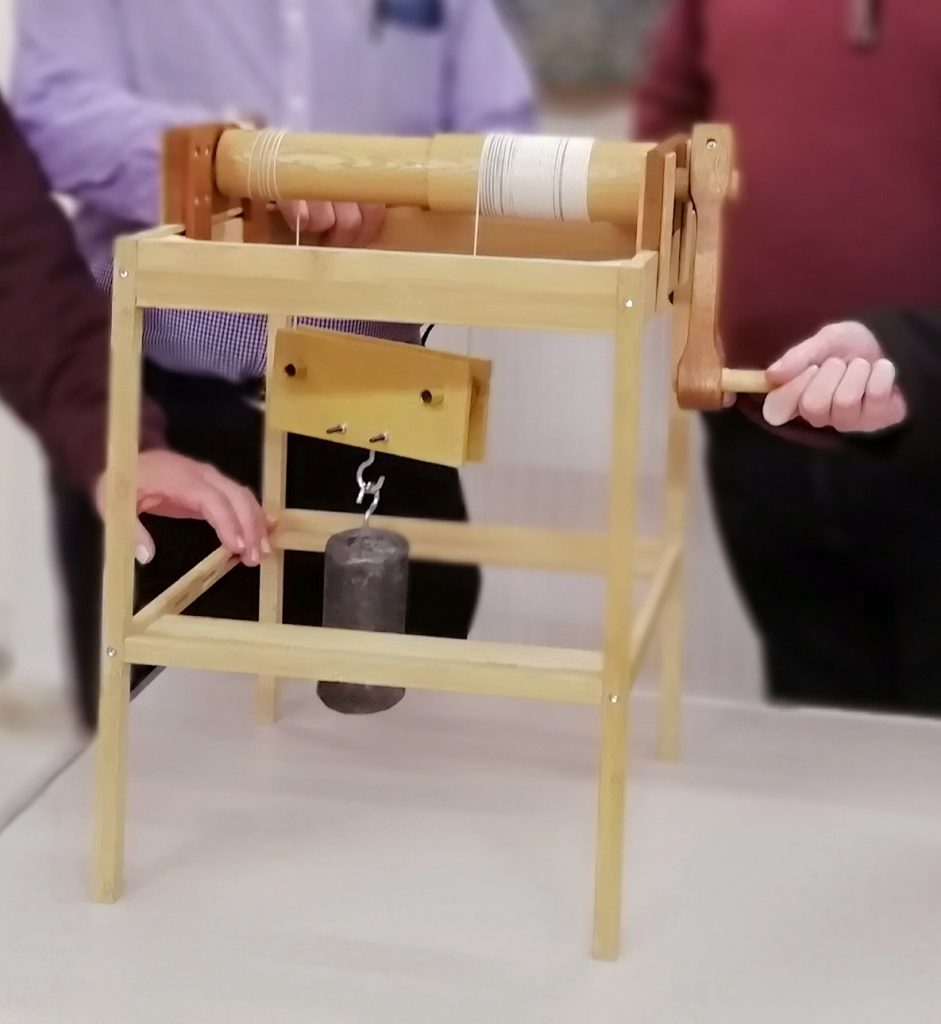
Charles clearly loves his construction projects, as he also brought along a differential windlass that he’d built for members to have a play with.

On behalf of Colburn and Richmondshire District Amateur Radio Society, we’d like to extend our thanks to Charles for taking his time to come and visit us, and show off his various projects.

AGM and related matters

The CRDARS Annual General Meeting took place on Wednesday 3rd October 2018.

The following members were elected to roles on the committee:

Chairman Andrew Thornton
Vice Chairman Dave Lutman
Secretary Chris Kirby
Treasurer Irene Lyne
Additional Committee Member Paul Hunt

Founding members Colin Lyne and Chris Watkins have both stepped down from their committee roles this year. We’d all like to express our thanks to both of them for their work in making the club what it is today.

Colin has agreed to continue his work as the primary point of contact for new and prospective members, and Irene has once again agreed to continue as club treasurer. Thank you to both of you for all of your work in the background. It really is appreciated.

From October 2018, subs for members over the age of 18 will rise to £20 for the year. The £2 charge for the individual meetings will be eliminated. This should be simpler for everyone, and will result in an overall saving for members who attend more than five meetings during the year. Subs remain at £5 per year for under 18s.

We’d like to extend our thanks to AJ for the donation of a 2m mobile radio, and to Richmond School Amateur Radio Society for the donation of a 2m/70cm collinear antenna.

The club has reluctantly agreed that we are not in a position to run a JOTA station for the scouts this year, although we hope to be able to put a suitable team together and run a JOTA station in future years.

Colburn Village Hall is no longer available for us to use as an examination venue. Arrangements are currently being made to register Hudswell Village Hall as our new exam centre, so we should be able to offer examinations at Hudswell in the near future.

The club is currently exploring whether or not it’s financially viable for us to repair a donated Yaesu FT-757 transceiver. If so, this is likely to become our main HF radio. Thanks to Paul Hunt for taking the time to investigate this.

A working party has been arranged to erect the club’s HF antenna, on at least a temporary basis. Hopefully this will make it easier for our members to use our G5RV until both antenna and feeders can be permanently installed. Thank you to everyone involved for your time and hard work.

As the club now meets on the 1st and 3rd week in any given month, there is the possibility that the club may hold a second December meeting on the 19th, likely depending on whether there is any interest in meeting so close to Christmas. A decision will be made closer to the time, and details will be posted to the web site once we know one way or the other.

Finally, it has once again been suggested that we attempt to hold a short, regular 2m club net. In the past, we’ve found that Sunday evenings have been inconvenient for a lot of our members, so we’re trying to come up with an alternative day or time when the majority of members can get on the air for 15 minutes or so.

Upcoming 6m VHF Talk (17th October)

On 17th October, Clive (G4FVP) will be giving a talk on the VHF amateur bands. Clive has a reputation for being extremely knowledgeable when it comes to VHF, and the 6m amateur band in particular. If you’re interested in taking a step beyond basic “line of sight, plus a bit” FM contacts and would like to explore more of what the VHF bands have to offer, this is an opportunity to learn from one of the experts.

We’re always happy to see new faces at our club meetings, so even if you’re not a CRDARS member, you’re more than welcome to join us for what will no doubt be a very interesting evening.

HF digital modes talk postponed

The proposed beginner’s introduction to HF digital modes, originally scheduled for 19th September has had to be postponed.

Both Andy and Martyn were originally planning on experimenting with HF digital modes (such as FT8 and PSK31) from home, with the intention of providing a practical demo of what we’d been doing and what we’d learned along the way. Unfortunately, we’ve both run into problems getting our rigs, interfaces and software to communicate with each other, so neither of us have had any real success so far. We’ll both continue to experiment, and hope to be able to reschedule our demo for a future date, once we manage to get the kinks ironed out.

In the meantime, several club members have offered to assist with getting the club’s G5RV antenna erected so that it’s available for members to use during our weekly meetings. We’d like to extend a big thank you to everyone who’s offered to assist, and we look forward to reaping the benefits of a permanent antenna in the not too distant future.

C4FM for Beginners

On 18th July, members were given a beginner’s introduction to simplex operation using Yaesu’s C4FM (Fusion) digital mode.

Yaesu have an introductory video for Fusion, which I found quite helpful when preparing for the talk:

In the UK, 144.6125 is designated as the 2m digital calling channel. Use this for CQ calls using C4FM or other digital modes. Once you’ve established contact, move to a standard FM simplex channel, or use the all modes section of the band. The 144.6375 – 144.7875 range is recommended.

Most Yaesu C4FM radios are capable of five different modes of operation:

Mode Appears as Used for
FM FM Conventional FM for communication with non-digital users.
V/D (Simultaneous Voice and Data) DN Error corrected digital voice. This is the “normal” C4FM mode.
Voice FR (Full Rate) VW Higher bitrate digital voice, allowing for better audio quality when error correction is not required.
Data FR (Full Rate) DW Sending text or images between C4FM radios. You cannot select this mode manually. Your transmitter will automatically switch to this mode when you use a feature of your radio that requires it.
AMS (Automatic Mode Select) Bar above active mode The radio will transmit using the displayed mode, but will automatically switch to other modes upon receiving a transmission using one of the other modes.

The following two videos provide an introduction to analog to digital conversion, and to digital error correction techniques.

A few things to take away from these videos:

  • We need to sample our audio at twice the highest audio frequency we wish to transmit.
  • We have a fixed amount of bits that we can transmit over a 12.5KHz FM channel.
  • Higher audio quality requires more bits to be dedicated to audio data.
  • Error correction requires more bits to be dedicated to checks on our audio data, at the expense of audio quality.
  • We have to make trade-offs between audio quality and reliability, hence the two different voice modes with different priorities.

Summer Hiatus and Nets

Please note that CRDARS does not meet during the month of August. Our next meeting will take place on Wednesday 5th September.

Some of our members have suggested a club net during the summer break. We’d recommend listening out for fellow members on the 1st and 15th August on the GB3IR repeater (145.7625) at around 19:30.

Planning, equipment and finances

At our last meeting on 16th May, some more discussion took place regarding the future of the club.

Finances have been tight lately, with the club making a net loss on many of our recent meetings. This is due to a combination of a more expensive venue, increasing costs and a slight drop in the number of members attending on a regular basis. It has been suggested that the cost per meeting be increased to £3 each, and there has also been a proposal to increase annual membership fees from October. Our Annual General Meeting is provisionally scheduled for 3rd October, and we expect to formally put these proposals to our members during the AGM.

We’re keen to have radio equipment available for use at our future meetings. To tide us over until Dave has chance to repair the Yaesu rig, Richmond School has offered to provide an ICOM IC-735 on loan. AJ has also offered the club a 2m radio, which should allow us to establish a regular presence on VHF.

Once we’ve got an antenna permanently erected, Colin is keen to do some more promotion of the club, through local media such as richmond.org and Richmondshire Today. Chris Watkins has offered to set up a YouTube channel, giving us both a promotional platform and somewhere to preserve footage of some of the club’s activities. Colin also intends to begin promoting Jamboree on the Air within the Scouts, and has suggested hosting the event up at Hudswell this year.

Finally, we’ve got a couple of presentations scheduled for the meeting calendar. A few members have expressed an interest in C4FM and HF digital modes, but aren’t really sure how best to get started. A couple of members have therefore offered to “have a go” at home, and provide some demos showing what they’ve learned. We’ve had a look at some of the more interesting capabilities of these modes in the past, but we’d like these events to be a bit simpler and more practical, in the hopes that we can get a few more people “over the hump”, and get them up and running with these modes. Dates are on the meetings page.